Get in touch

KHEISH · PERSISTENT AGENT RUNTIME

Agents thatoutlive the caller.

Kheish is the open-source daemon that runs the lab’s agents. A CLI, a Slack message or a webhook only asks; the daemon executes, journals every turn, waits for a human when it must, and stays accountable for every action an agent takes.

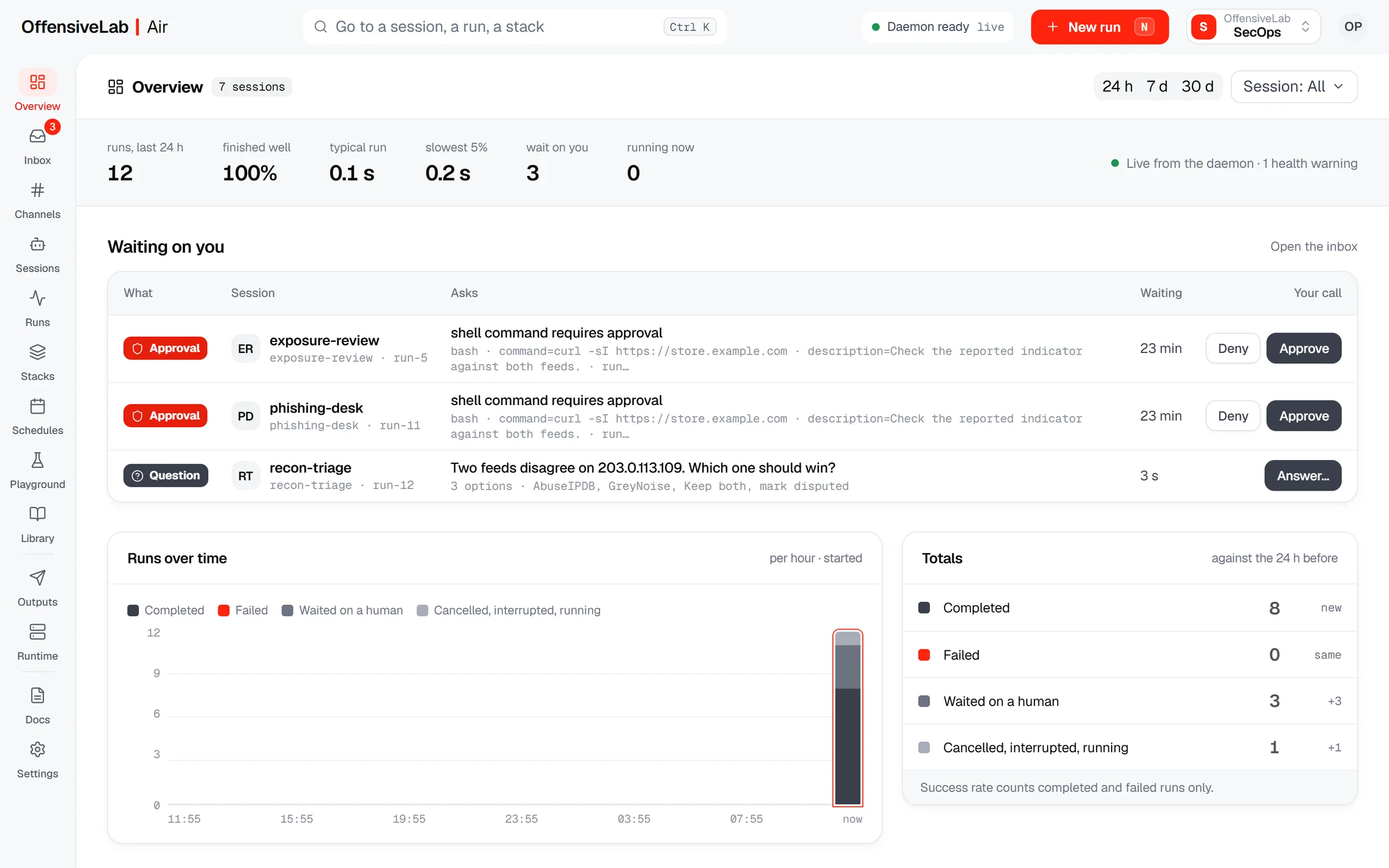
Air Overview on a Kheish daemon: runs in the last 24 hours, what waits on a human (a question and two approvals), runs over time and totals.Open the full-size screen
A Kheish daemon at work, seen through Air, its console: what waits on a human, runs over time, totals.

Real screens of Air on a local Kheish daemon, with demo sessions.

  • 59built-in tools, from files and shell to scheduling, sub-agents and channels
  • 211HTTP API paths, described in OpenAPI and driven by the same binary’s CLI
  • 5model providers: Anthropic, OpenAI, Google, OpenRouter and xAI

THE INVARIANT

The caller asks. The daemon runs.

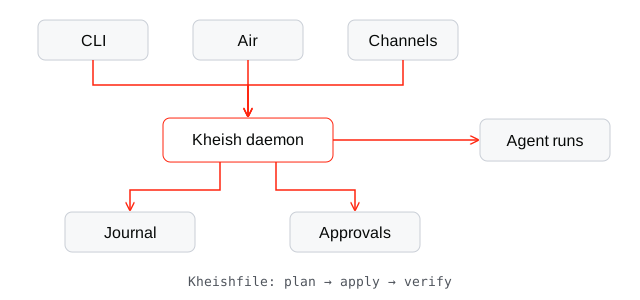
Whoever asks for a run, the CLI, Air, a channel, a webhook or your own code, only submits it. The daemon executes it, writes every turn to an append-only journal and keeps it under a named authority with a stated scope. The caller can disconnect, crash or never come back.

Kheish runtime: the CLI, Air and channels submit to the Kheish daemon, which runs agents and keeps a journal and approvals; a Kheishfile is planned, applied and verified.
Conceptual architecture: callers submit, the daemon owns the execution.

THE TOUR

Durable, governed, declarative.

RUNS

Runs that survive their callers.

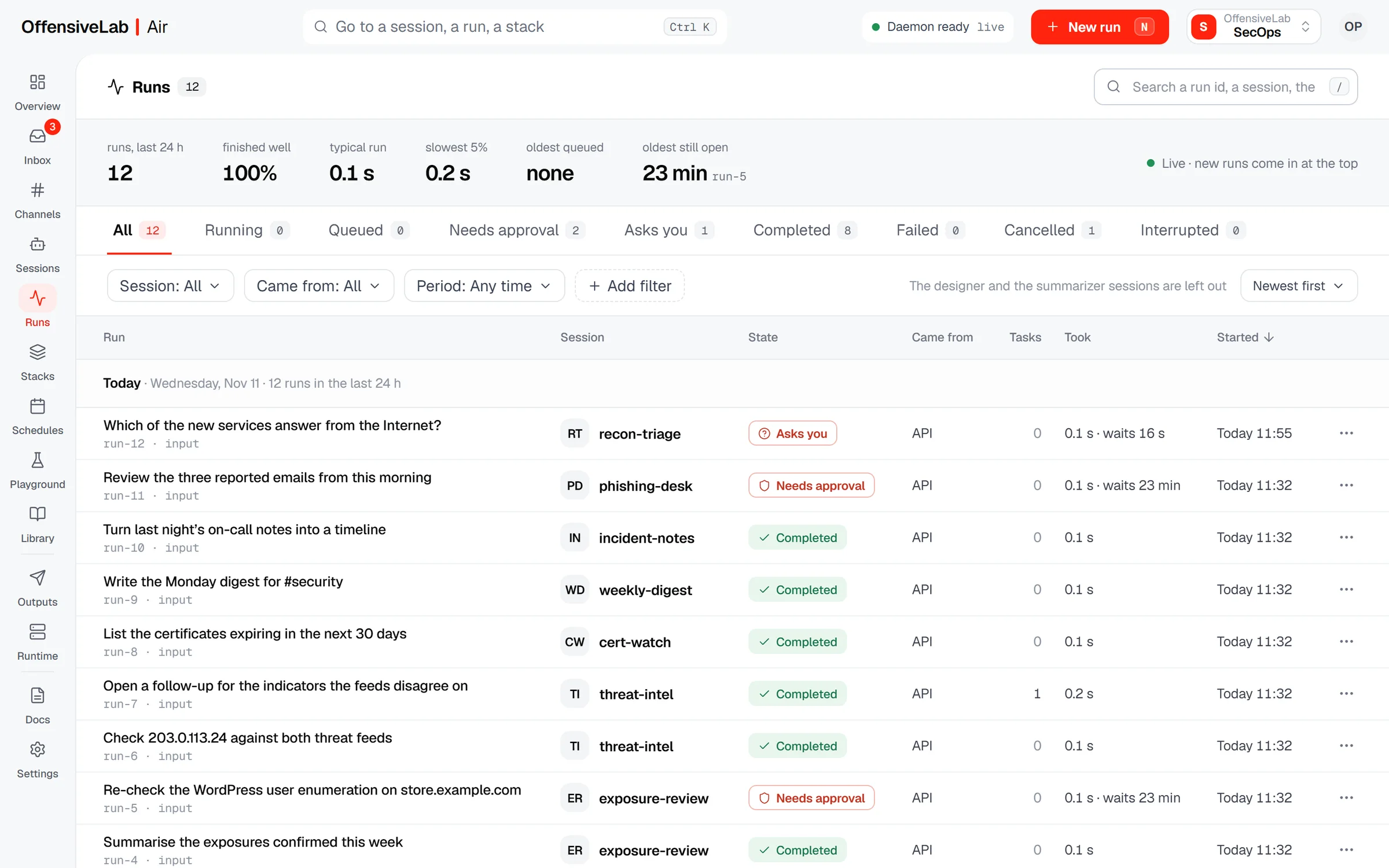
A session holds one active run and a queue behind it. Every turn is flushed to an append-only journal; after a restart the daemon rebuilds its queues and schedules, runs waiting on a human come back still waiting, and nothing is silently lost.

  • Eight run states, from queued to interrupted
  • Input and output contracts, checked fail-closed
  • Idempotency keys on inputs, approvals and answers
GOVERNANCE

Nothing risky runs without a yes.

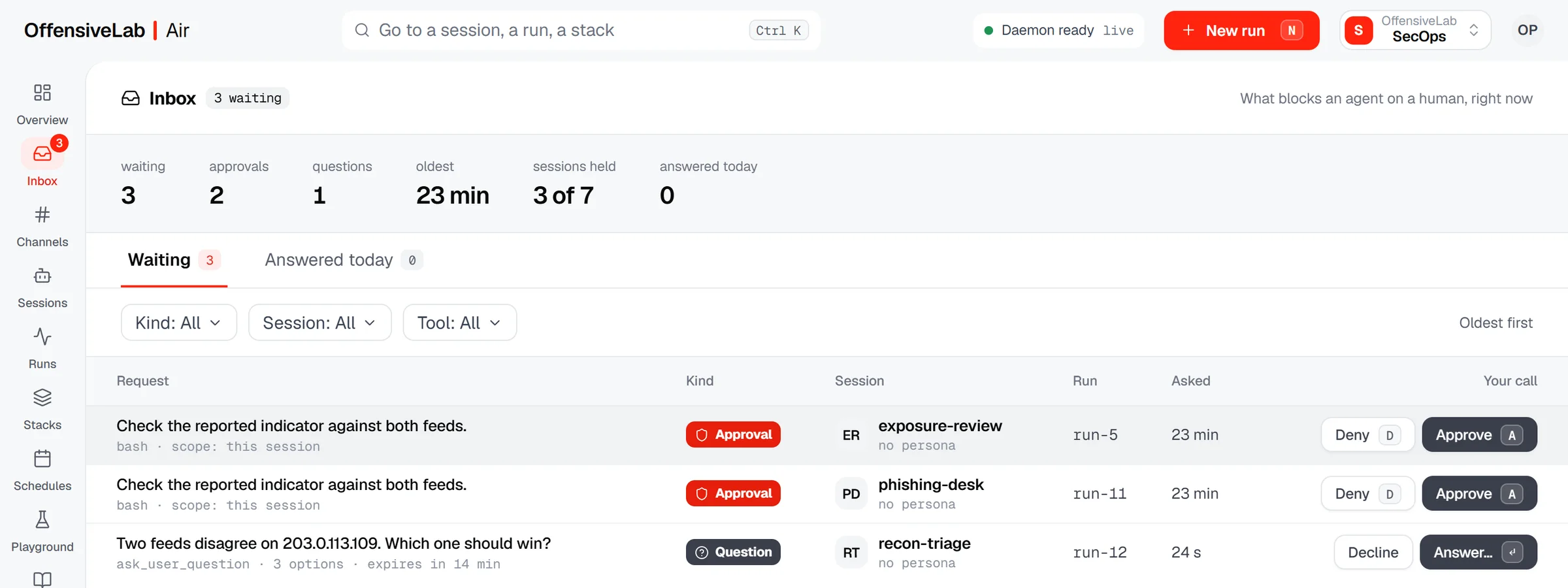
Five permission modes decide what asks first. An approval shows the exact tool input, and the approver can edit it before allowing; a question offers up to four structured choices and can expire.

  • Approvals with an edited input and a justification
  • Questions with options, free answers and an expiry
  • Capability and credential scopes, narrowed for every sub-agent

STACKS

Agents as code.

A Kheishfile declares personas, sessions, schedules and their scopes. The daemon plans, applies in reconciliation order and verifies, records what it owns in a ledger, and refuses any scope wider than declared.

  • init, validate, plan, diff, apply, verify, import, down
  • Secrets referenced and fingerprinted, never stored
  • Drift from the manifest detected
Kheishfile.yaml, from examples/stacks/linear-triage-daily
apiVersion: kheish.ai/v1alpha1
kind: KheishStack
metadata:
  name: linear-triage-daily
spec:
  apply:
    strict_scopes: true
  requires:
    secrets:
      - ref: mcp.linear.LINEAR_API_KEY
  personas:
    - persona_id: linear-triage-operator
      soul_file: persona.md
      capability_scope:
        mcp_server_allow: ["linear"]
  sessions:
    - session_id: linear-triage-daily
      persona_id: linear-triage-operator
      credential_scope:
        route_allow: ["openai"]
        connector_deny: ["*"]
  schedules:
    - name: linear-triage-daily
      target_session_id: linear-triage-daily
      cadence: { type: interval, every_seconds: 86400 }
      overlap_policy: skip

AUTOMATION

Work that starts on its own.

Schedules fire once, at an interval or on a cron with seconds and time zones, with overlap and misfire policies. A session goal keeps an idle agent working toward an objective, within a token budget.

  • Pause and resume keep the remaining time
  • Durable wake-ups an agent sets itself
  • At-least-once deliveries, with dead letters and replay
kheish-daemon schedules
$ kheish-daemon schedules create morning-triage triage \
    --cron "0 0 9 * * *" --timezone Europe/Paris \
    --overlap-policy skip \
    "Triage the issues opened since yesterday"

$ kheish-daemon schedules pause schedule-1
$ kheish-daemon schedules trigger-now schedule-1

MODEL ROUTES

Five providers, one routes file.

Routes are declared in TOML and can be added or removed while the daemon runs. Each run is pinned to its route, and a fallback model takes over once after a rate limit or an outage.

ProviderNative web searchImagesAudioTranscription
anthropicyes———
openaiyesyesyesyes
google—yes——
openrouter—yesyesyes
xaiyesyes——

A pack that keeps walking.

Sub-agents split the work: plan, verify, coordinate, each in the shared workspace or its own git worktree. A child never gets more permission than its parent, and quotas bound depth, fan-out and spend.

COMMAND LINE

One binary, daemon and client.

The same kheish-daemon executable serves the API and drives it, with 31 commands over sessions, runs, approvals, stacks, schedules and more.

kheish-daemon up# start with zero config, open the console

kheish-daemon sessions create triage --persona-id analyst# a durable session

kheish-daemon sessions input triage "Triage the new issues"# submit, then leave

kheish-daemon approvals allow triage <request-id> --justification "read-only"# a human says yes

kheish-daemon runs wait run-42# come back when you want

kheish-daemon stack apply -f Kheishfile.yaml# agents as code

ACCOUNTABLE BY DESIGN

Every action under a named authority.

  • Signed audit

    External actions go to an append-only, hash-chained ledger signed with Ed25519, fail-closed.

  • Brokered leases

    Routes, connectors and MCP servers get short-lived, revocable credential leases, never raw keys.

  • Write-only secrets

    One encrypted store under a master key; a secret can be set or used, never read back.

  • Hooks

    27 events and 5 executor types, failing open or closed, with their own dead letters.

  • Guarded network

    Outbound HTTP, web fetches and hooks are protected against server-side request forgery.

  • A stated threat model

    The docs say what Kheish does not protect against: a compromised host, a leaked master key, the model itself.

EVERY FEATURE

Everything the daemon does.

The full list, area by area, as the code ships it today.

Durable execution

  • Append-only journal, flushed three times per turn
  • Restart recovery of queues, approvals, questions, schedules and deliveries
  • A run cut by a restart is marked interrupted, never silently dropped
  • Idempotency keys on inputs, approvals and answers
  • Offline journal vacuum with a verified, atomic swap
  • One state root, locked by a single daemon

Sessions and runs

  • One active run per session, with a queue behind it
  • Ten run kinds: input, goal, schedule, mailbox, channel, resumes and more
  • Input and output contracts, fail-closed, with a repair budget
  • Personas: a soul, a scope and default skills, snapshotted per session
  • Goals that keep an idle session working, within a token budget
  • A turn ceiling and a daemon-wide model budget
  • Automatic context compaction, with hooks before and after
  • Images and audio as input, and a file store for assets

Sub-agents and tasks

  • Sub-agents typed default, plan, verification or coordinator
  • The shared workspace or a git worktree per child
  • Mailboxes with acknowledgements and dead letters
  • A child’s question surfaces on its parent’s session
  • Background tasks with their output kept on disk
  • Quotas on depth, fan-out, spawns and spend

Governance

  • Five permission modes, with rules per user, project and session, and a dry-run explainer
  • Approvals that can edit the tool input before it runs
  • One to four questions per request, each with two to four options, and an expiry
  • Capability and credential scopes, intersected with the persona’s
  • Brokered, short-lived, revocable credential leases
  • Operator contact: notify or ask a named human

Tools and integrations

  • 59 built-in tools: files, shell, patches, search, web, media, scheduling, agents
  • MCP over stdio or HTTP, with OAuth, resources and a catalog of 17 servers
  • Model routes and MCP servers added live, without a restart
  • Per-session route policy with reasoning effort and budgets
  • Byte, time and parallelism limits on tools, tunable live
  • 78 bundled skills, plus your own SKILL.md
  • Connectors for Telegram, Slack and signed HTTP
  • Sidecars for Discord, email, SMS and webhooks; Matrix best-effort; Signal and WhatsApp experimental
  • Encrypted, write-only secret store; Codex and Claude Code accounts importable

Automation

  • Schedules: once, at an interval, or cron with seconds and time zones
  • Overlap and misfire policies, pause and resume
  • Stacks: plan, diff, apply, verify, import and tear down, with an ownership ledger
  • Playbooks released through verified, canary and active
  • Flows that require evidence before they complete
  • At-least-once deliveries, dead letters and replay

Collaboration

  • Channels where people and agents talk, with threads and reactions
  • @mentions, four participation modes and turn leases against reply storms
  • An autonomy policy: speakers, cooldowns and quiet periods
  • Projects with task dependencies that agents claim themselves
  • Boards: shared whiteboards agents draw on

Memory and learning

  • Recovered run memory, scrubbed of personal data
  • Learnings: facts, preferences and decisions, scoped to a session, persona, project or workspace
  • Shadow mode by default; anything that looks like a secret is rejected
  • Procedures promoted to skills through draft, verified, canary and active

Capture

  • Screen, webcam and microphone sources, each with its own upload token
  • Transcription and previews as derivations, turned into runs at once or on a schedule
  • Capture agents provisioned per machine, revocable in one command

Interfaces

  • One binary: the daemon and 31 CLI commands
  • 211 HTTP paths, described at /v1/openapi.json
  • A live event stream that resumes from the last event seen
  • Admin and read-only tokens; loopback-only CORS by default
  • SDKs documented for Python, TypeScript, Go and Rust
  • Air, the web console

Operations

  • kheish-daemon up: start with zero config and open the console
  • A Docker image that runs as non-root and refuses unsafe config
  • Liveness, readiness and a status with health warnings
  • Prometheus metrics for connectors and deliveries
  • Runtime settings as versioned revisions, with rollback
  • Encrypted debug capture, and a doctor that checks routes and credentials

Run your agents on Kheish.

Kheish is open source under the Apache 2.0 license. Start a daemon with one command and the console opens in your browser.