Get in touch

GATEWAY · UNIFIED TOOL ENGINE

One engine.Typed results.

Gateway puts every reconnaissance and security tool the lab uses behind one contract: a task goes in, typed observations and their measured coverage come out. Fregate runs all of its scans through it.

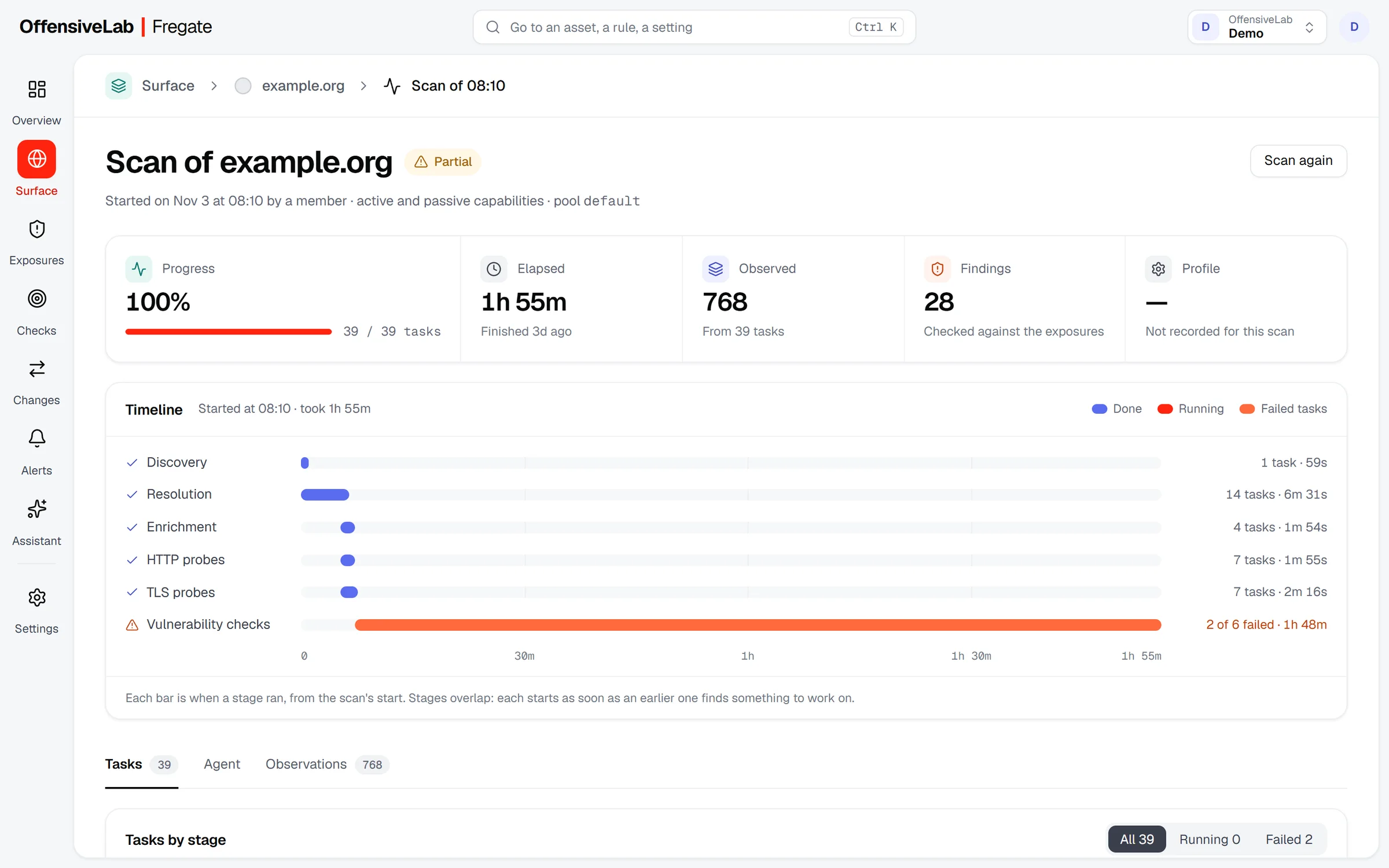
A Fregate scan run by Gateway agents: 39 of 39 tasks, 768 observations and 28 findings, with a timeline of discovery, resolution, enrichment, HTTP probes, TLS probes and vulnerability checks.Open the full-size screen
A scan as Gateway ran it for Fregate: each stage is a capability, each bar the tasks the agents ran.

A real screen from a demo workspace. Hostnames and addresses are replaced with documentation values.

  • 10capabilities, from subdomain discovery to active web tests
  • 3modes, passive by default: active to touch a target, intrusive to test it
  • 1pinned release of vulnerability checks, verified by hash on every agent

HOW A TASK RUNS

In through one door, out as facts.

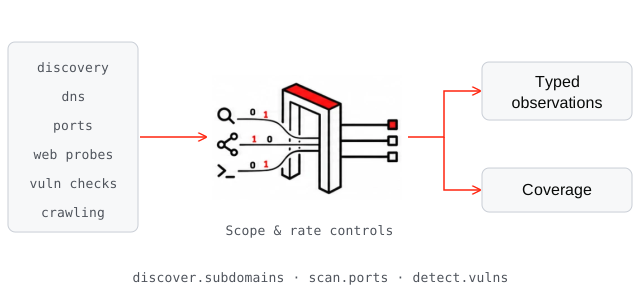
A task names a capability, its targets and a maximum mode. The runner admits the targets, runs the tool behind a monitored network, then validates every fact before it leaves, with the coverage that says what was really checked.

Gateway pipeline: discovery, DNS resolution, port scans, web probes, vulnerability checks and crawling run behind Gateway under scope and rate controls, and come out as typed observations with their coverage.
Conceptual pipeline. Absence counts as proof only when coverage is complete.

IN FREGATE

What the engine hands over.

CATALOG

Every template, classified once.

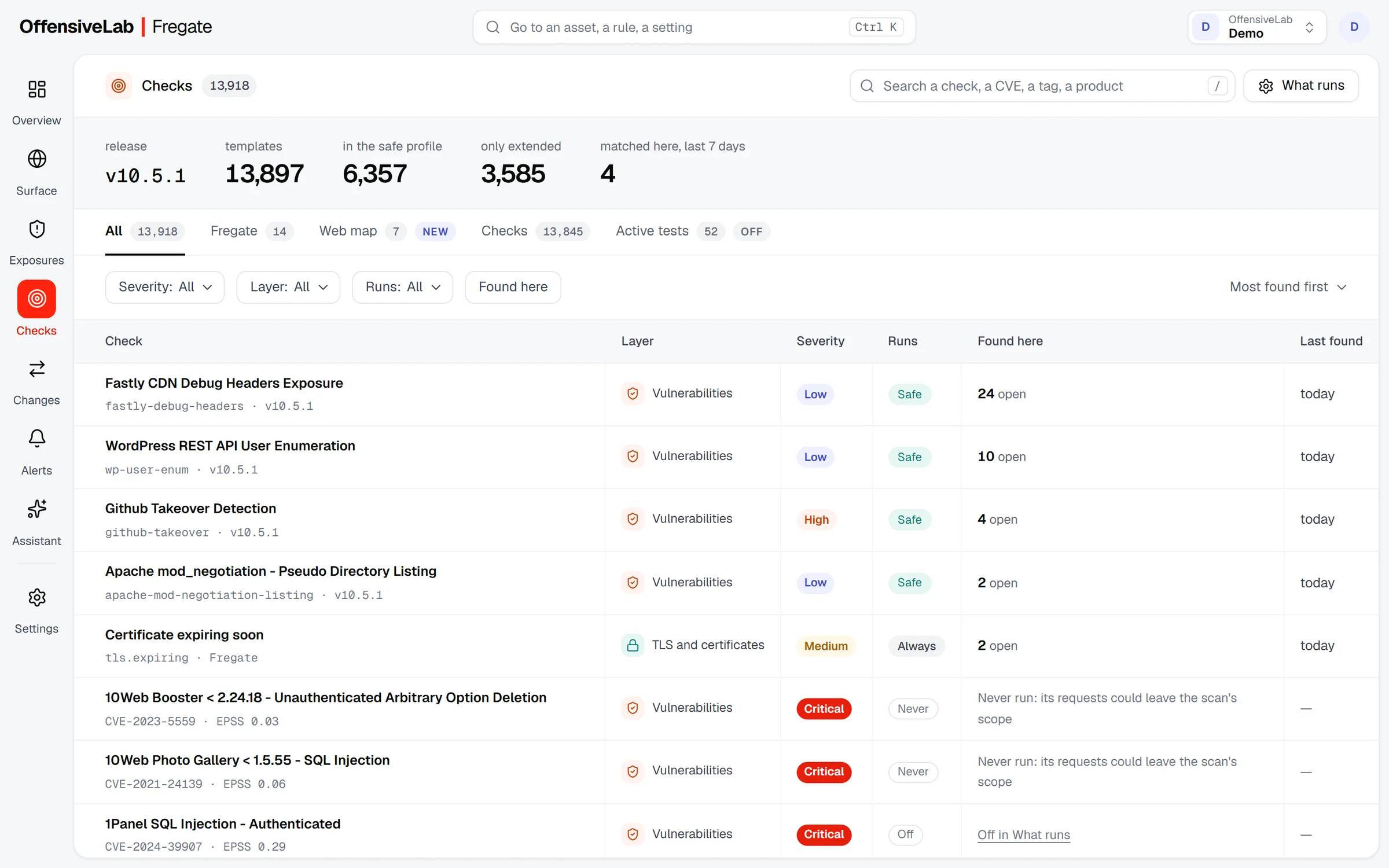
Agents classify the pinned release of vulnerability checks into a catalog: severity, CVE, CWE, CVSS, EPSS, the profiles that run each template and, when the safe one does not, why. Fregate shows it as it is.

  • Built once per release, cached with the bundle
  • Streamed to the control plane on request
  • The same rules as the scans themselves

CAPABILITIES

What Gateway can run.

Each capability takes canonical targets, does one job and emits one kind of typed fact, whatever engine runs behind it.

CapabilityWhat it doesTakesEmitsMode
discover.subdomainsFinds the hostnames under a domain, from passive sourcesdomainhostnamepassive
enrich.ipSays who runs an address: cloud, CDN or networkipip_infopassive
resolve.dnsResolves names to their DNS recordshostname, domaindns_recordactive
scan.portsFinds the open ports of addresses and rangesip, cidrserviceactive
identify.servicesNames the service behind each open portserviceserviceactive
probe.httpReaches web endpoints: status, title, technologieshostname, url, servicehttp_endpointactive
probe.tlsReads certificates and TLS settingshostname, servicecertificateactive
crawl.webMaps a site’s pages, forms, scripts and endpointsurlweb_resourceactive
detect.vulnsRuns vulnerability checks on sites and servicesurlfindingactive
test.webActive web tests: injection, XSS, SSRF and moreurlfindingintrusive

Agents that only know their tasks.

In production, Gateway runs as scan agents with no database access. They lease tasks from a control plane over ConnectRPC, send their events back in acknowledged batches, and pick up where they stopped after a disconnect.

COMMAND LINE

The same contract, from a terminal.

Every capability runs locally too. The default mode is passive: nothing touches a target without --mode active.

gateway providers# capabilities and their tools

gateway run discover.subdomains example.com# passive by default

gateway run probe.http --mode active www.example.com# typed http_endpoint facts

gateway run detect.vulns --mode active --params '{"tags":["misconfig"]}' https://www.example.com/# vulnerability checks, safe profile

gateway agent --server https://control.example.com --token …# lease tasks from a control plane

GUARD RAILS

Enforced by the runner, never by the tools.

  • Admission

    Canonical targets and a maximum mode; private and reserved addresses refused; at most 500 targets per task.

  • Monitored network

    Every connection is checked against scope, exclusions and rate as it opens, and cut when the task ends.

  • Validated output

    A fact that does not derive from its target is dropped as out of scope.

  • Identified traffic

    Every HTTP request says who sends it: offensivelab-gateway/1.

  • Evidence

    A finding keeps the request and response it came from, capped, with credentials masked.

  • Honest coverage

    A timeout or a refused connection never counts as a check: coverage stays partial.

Run your tools through one door.

Gateway is built in the lab and powers every Fregate scan. Talk to us to see it on your own scope.